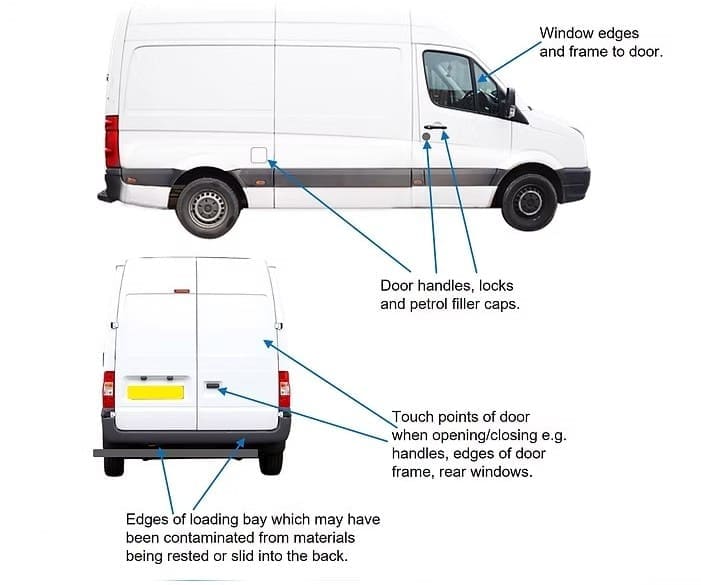
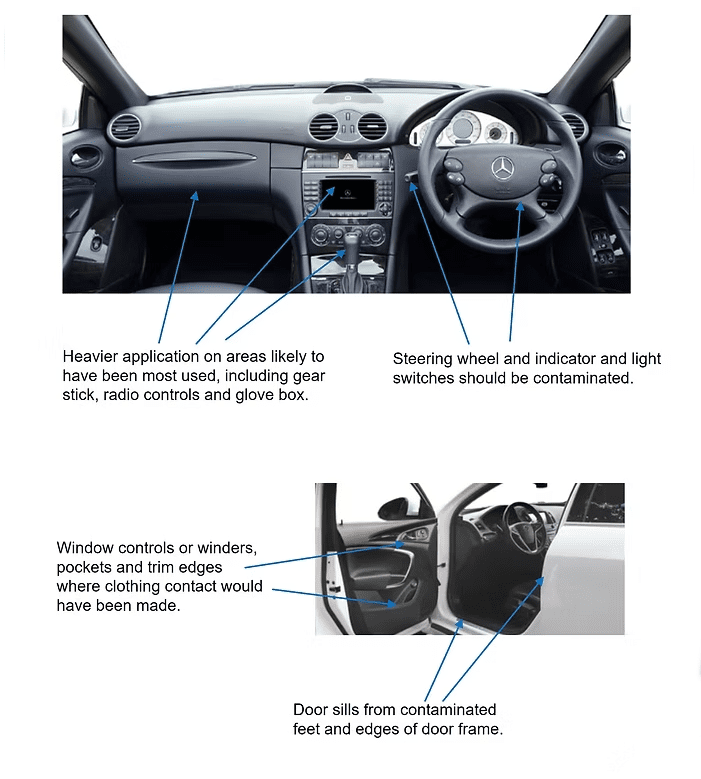
A vehicle can be used very well to show the effects of contamination and its spread through a scene. LS1 spray can be used either directly onto the areas or can be sprayed onto a cloth and then applied to required areas to give a lower concentration – and to make detection more difficult. This scenario is ideal for training teams dealing with border control operations, lost sources & potential IED’s containing radiological material to ensure that evidence is gathered correctly without further cross contaminating the scene.
Suggested application points for LS1 spray to show contamination of vehicle…
Every organisation has a different view on how such situations should be handled and while this is in no way meant to suggest best practice, the below is simply a set of points which can be incorporated into an exercise and where appropriate what the limitations of the equipment may be.
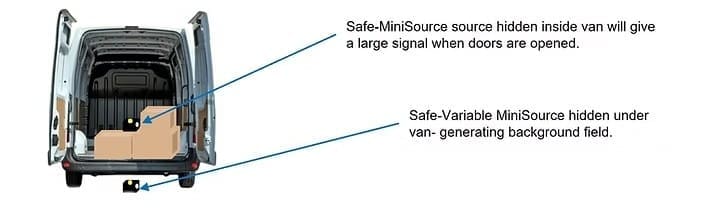
A scenario like this would usually be investigated with use of an instrument such as the Thermo Electra with a HP260/DP6 probe. We will assume the area has been surveyed for potential radiation fields and deemed safe to enter. Optionally, you can enhance the scenario by using STS Safe Series to generate a simulated radiation field outside the vehicle and replicate a source inside the vehicle.
This can be achieved by; secreting Safe Variable MiniSource under vehicle set on low power to generate a ‘radiation field’. Next, trainees would be instructed to open the vehicle, revealing a hidden directional source hiving out a much stronger signal from the now open vehicle.
Suggested instruments for this scenario
Having dealt with and removed the source, the team will now monitor for contamination of the vehicle and the scene, After applying LS1 spray as suggested above, the team would go on to methodically determine which areas were contaminated and to what extent. The team would then check the inside of the vehicle to gather any evidence required. LS1 spray is a liquid that evaporated over time and gives off harmless gas which is measured by the instruments. The team should bear in mind when setting up an exercise that in very warm conditions, the liquid evaporates quicker and thus the ‘contamination’ will disappear. For example, in direct sunlight, it may only last 30-45 minutes. Since LS1 truly demonstrates cross contamination, it also makes good training use for the search team to then check each other for cross contamination that they may have collected while investigating the scene. Instruments should too be checked for contamination that may have been passed on to them through contact with the vehicle or contaminated users’ hands.









Customers like the concept of both the contamination simulators as well as the dose rate simulators.

We have been working with STS for a number of years and we value our relationship with them. They continue to be an important supplier in the provision of services and solutions, to support our work in radiation monitoring in a secure and safe environment.

A lecturer in applied physics and in radiation protection at Aix Marseille University in France. I have been using STS products for 6 years, and I highly recommend them. Easy to use and very realistic…

The equipment we purchased has been brilliant and has made a real difference to some of the training we are doing here at Dungeness B Power Station. Further to this, you managed to meet our tight time frames, and get this equipment to us in such a short space of time which was exceptional service and is truly appreciated, thank you!