PRODUCTS AND SERVICES

FIXED MONITOR SPEC

PRODUCTS AND SERVICES

SEMI-PORTABLE MONITOR SPEC

How it Works

Discover how the siloxane monitor works and its applications in the field

Siloxane Monitoring
Siloxane Monitoring
Technology
Technology
Instrument Formats
Instrument Formats
Application
Application
  • On-site, on-line 24/7, 365 analysis of Siloxane contamination in gas streams
  • Suitable for Landfill gases, Sewage Derived AD plants and Food Waste AD
  • Designed to give trending measurements of the health of Activated carbon filters used to remove Siloxanes form the Gas Stream
  • Quantification of total Siloxane loading in mg/m3 of the cyclic (D3-D6) and the linear (L2-L4) siloxanes
  • Data available on monitor, downloadable from SD card, via telemetry to hosted web service and may be integrated into customers SCADA.
  • The siloxane monitor is designed to be an all-in-one solution providing sample collection, gas handling and conditioning, measurement and analysis.
  • Samples are supplied to the meter via PTFE tubing connected to the upstream and downstream sample points- this has a restricted flow to reduce any potential leaks and a coalescing filter to remove any final residual moisture.
  • The sample is then passed into a concentration column -similar to a GC- this concentrates the Siloxanes over the sample period (usually 15mins) rejects the unwanted constituents before being purged with Nitrogen carrier gas and sent to the measurement chamber
  • The measurement is made using a Non Dispersive Infra-Red technique with the measurement made being over a specified time frame as the concentrator is heated to release the Siloxanes. The technique is well established and robust for field measurement. Additionally, the detector and the IR source are housed behind windows in the measurement cell so are not exposed to harsh contamination ensuring a long operational life.
  • Finally, the resulting measurements are processed and displayed or sent to the web/SCADA interfaces – a measurement is made approx. once every hour.
  • Up to 3 samples points can be measured on a rotational basis
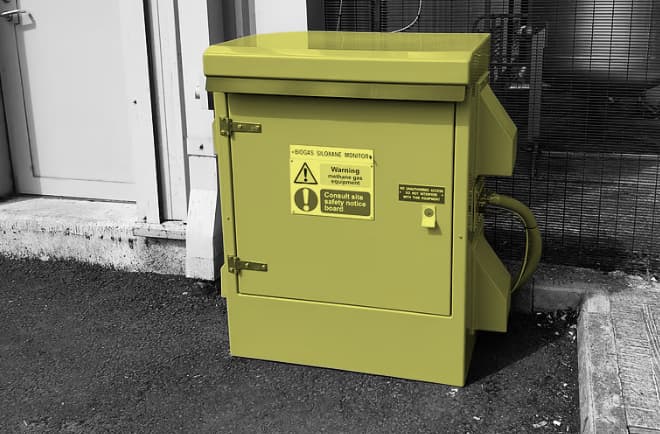
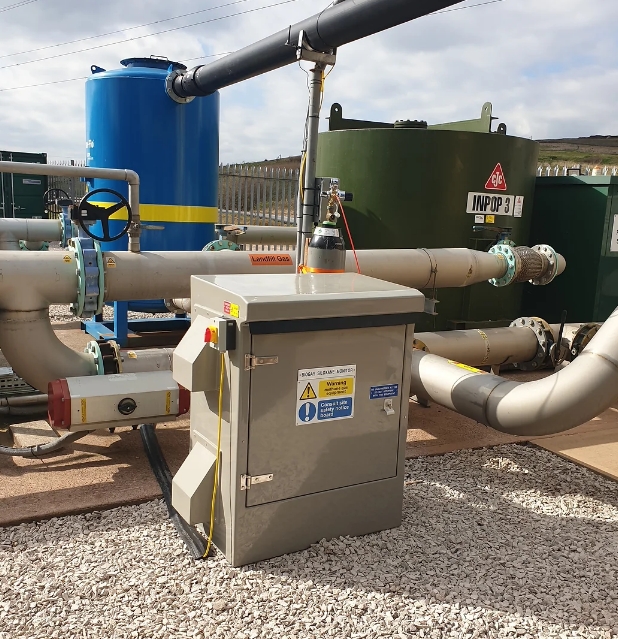
  • Fixed installed kiosk
    • GRP single door Kiosk with Cross forced ventilation
    • All incoming connections are glanded to reduce potential connector leakages
    • Unit may be wall mounted – or can be supplied with a Galvanised Unistrut frame and rain/shade canopy
    • A power distribution section features under voltage trips which in the event of power outage will prevent the unit from restarting before the instrument is confirmed purged.
    • Onboard methane and temperature sensors initiate Safe mode should they exceed LEL or temperature thresholds.
    • Requires and N2 bottle supply and mains power.
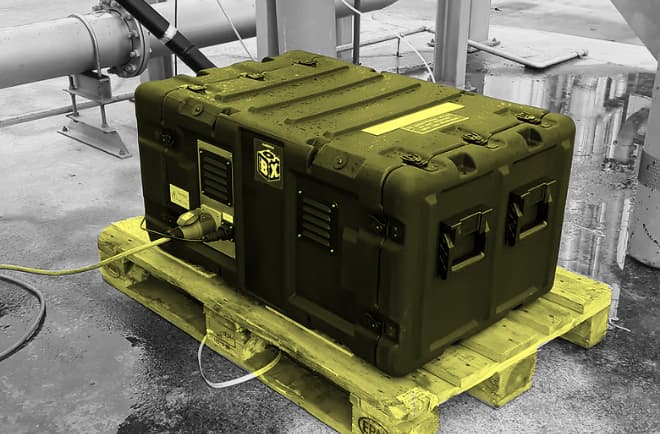
  • Semi Transportable Style
    • Supplied in a large wheeled weatherproof Peli case for transportability
    • Features 2 sample point monitoring
    • Is a simpler version of the instrument measuring D Series Cyclic Siloxanes only
    • Requires N2 Bottle and Mains Power
    • Should be located out of direct sunlight or weather
  • Monitoring of biogas/landfill gas pre and post Activated Carbon filters to determine filter replacement at optimal time – before breakthrough but not before full capacity used.
  • Reduce Engine downtime and maintenance costs by ensuring Gas post filters is not damaging to engine components and resulting in derated performance.
  • Last line of defence before other processes such as gas to grid cleanup where membrane filters are particularly sensitive to siloxane contamination.
  • Protection of turbines and heat exchangers which are highly sensitive to siloxanes build up.
  • Environmental permitting – where siloxane output is required to be monitored to comply with permit requirements.

SILOXANE MONITORING CASE STUDIES

VIEW ALL CASE STUDIES

FAQS | Siloxane Monitoring

  • What are Siloxanes?

    Siloxanes are silicone-based compounds characterised by a chain of alternating silicon (Si) and Oxygen (O2) atoms. They are used for their softening, smoothing, and moistening action. They make products like deodorants slide on more easily, and leave hair and skin more soft and silky.

  • Where do Siloxanes come from?

    Siloxanes are in products that contain silicon such as silicone baking utensils and pans, baby nipples, and pacifiers, medical devices and implants, water-repellent windshield coating, construction lubricants and sealants as well as deodorant creams and moisturizers and shampoos.

  • How do you measure siloxanes in gas streams

    Sampling siloxanes in a gas stream will usually be done using GC-MS and FT-IR and is usually completed by taking gas bag samples to analysed in the laboratory. The STS siloxane monitor however is an in-field instrument that takes the sample directly from the gas stream and utilises a unique GC-NIR detection system to produce rapid measurements.

  • Can siloxanes be measured in the field

    In field measurement of siloxanes is possible given the correct instrument and the right sample handling- consideration must be given to the propensity for siloxanes to drop out into condensates and equally to stick to cold surfaces, careful sample handling is therefore essential to obtain an accurate result. On site instruments need also to be robust and able to withstand the contamination in the gas stream presented by numerous other compounds that can influence the true result. STS mitigates this issue by using a bespoke GC column to separate and concentrate the siloxanes prior to measurement in an IR chamber.

  • Is there a monitor to measure L2 - hexamethyldisiloxane?

    L2 is the smallest of the linear siloxane molecules and the hardest to effectively trap and measure. Selection of both the right media in a Gas Chromatography column and the correct detector are essential to effect an accurate result. Careful thermal management and timing of the release from the column must be made to ensure that the molecules are not lost before measurement. The new STS Siloxane Monitor V4.0 enables this capture and measurement outputting the result as a total Siloxane value in mg/m3.
Get A Quote

REQUEST A QUOTE

Sign up to Mailing List