How It Works

Discover more about how our simulators work and how the technology is used to replicate ionising radiation fields and surface contamination.


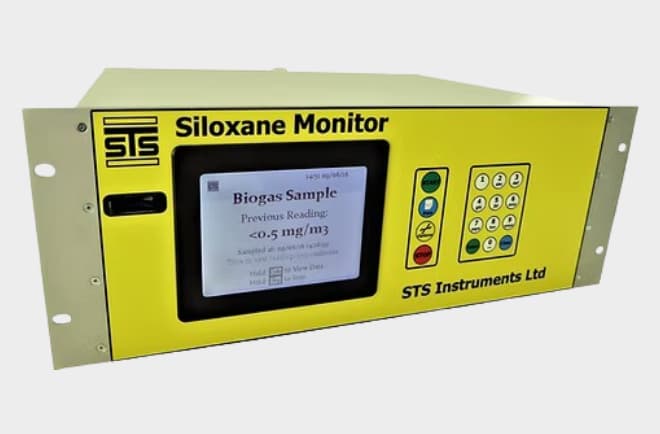
Siloxane Monitoring
Siloxane Monitoring
Technology
Technology
Instrument Formats
Instrument Formats
Application
Application
  • On-site, on-line 24/7, 365 analysis of Siloxane contamination in gas streams
  • Suitable for Landfill gases, Sewage Derived AD plants and Food Waste AD
  • Designed to give trending measurements of the health of Activated carbon filters used to remove Siloxanes form the Gas Stream
  • Quantification of total Siloxane loading in mg/m3 of the cyclic (D3-D6) and the linear (L2-L4) siloxanes
  • Data available on monitor, downloadable from SD card, via telemetry to hosted web service and may be integrated into customers SCADA.

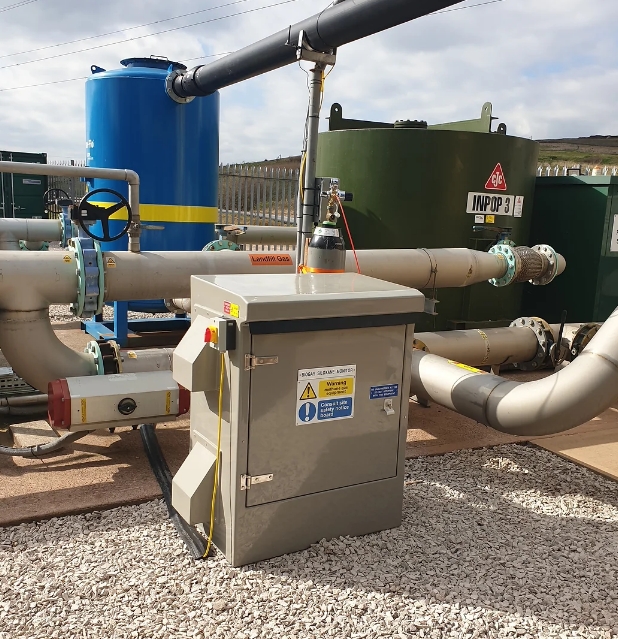
Fixed installed kiosk

  • GRP single door Kiosk with Cross forced ventilation
  • All incoming connections are glanded to reduce potential connector leakages
  • Unit may be wall mounted – or can be supplied with a Galvanised Unistrut frame and rain/shade canopy
  • A power distribution section features under voltage trips which in the event of power outage will prevent the unit from restarting before the instrument is confirmed purged.
  • Onboard methane and temperature sensors initiate Safe mode should they exceed LEL or temperature thresholds.
  • Requires and N2 bottle supply and mains power.

Semi Transportable Style

  • Supplied in a large wheeled weatherproof Peli case for transportability
  • Features 2 sample point monitoring
  • Is a simpler version of the instrument measuring D Series Cyclic Siloxanes only
  • Requires N2 Bottle and Mains Power
  • Should be located out of direct sunlight or weather
  • Smart Probes – these probes connect directly to a real unmodified rate meter and contain all the simulation electronics and detection circuits and also power supply- for example Smart DP6 probe used with a Real RadEye SX meter
  • Standard Probes – these probes contain only the detection circuit – they require power and signal from the host meter- this does mean they can be smaller in form such as a HP260 style frisker probe
  • Converted Meters – STS can take existing Contamination meters and convert them into simulated instruments this involves adding additional circuitry and sometimes power supply into the meter and interfacing with the meters electronics to feed the simulation signal in to the host device – for example the RamGene 1 MK11 or the Ludlum Model 3
  • Generic Meters – These meters are built entirely by STS from the ground up, they are designed to replicate the look and feel of real meters but with an up to date interface and display – they can be used with any of the STS standard probe range ie 44A, Dp6, Hp260 etc – an example of this is the Contamination Trainer or Contamination monitor Simulator
  • All in One/Dual instruments – These instruments provide a cross over by offering both a contamination and a radiation simulation- utilising 2 different technologies – The Dual FH40 can have either a contamination probe or a gamma probe connected
  • Monitoring of biogas/landfill gas pre and post Activated Carbon filters to determine filter replacement at optimal time – before breakthrough but not before full capacity used.
  • Reduce Engine downtime and maintenance costs by ensuring Gas post filters is not damaging to engine components and resulting in derated performance.
  • Last line of defence before other processes such as gas to grid cleanup where membrane filters are particularly sensitive to siloxane contamination.
  • Protection of turbines and heat exchangers which are highly sensitive to siloxanes build up.
  • Environmental permitting – where siloxane output is required to be monitored to comply with permit requirements.
Processing the Sample

Processing the Sample

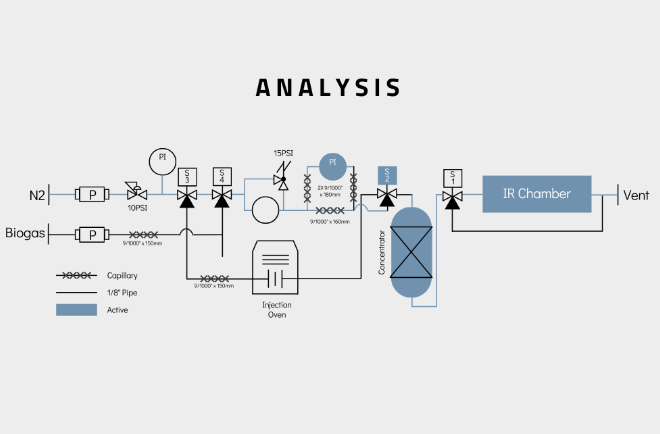
The STS Siloxane Monitor is designed to quantify siloxanes in biogas using NDIR (non dispersive infrared) technology. Siloxanes are particularly difficult to measure due to their “sticky” and persistent nature. Part of the challenge of making accurate measurements is ensuring that the measurement cell and concentrator are not contaminated after taking a reading. To alleviate this, the monitor is purged with nitrogen to remove any residues, and the concentrator is heated to drive off any residue which may not have been released, leaving it clean for the next cycle. The monitor records one reading per hour under normal conditions- approx 15mins are the sampling phase, 10 minutes the measurement phase, and the rest is cleaning and purging ready for the next sample.
Measurement Cycle

Measurement Cycle

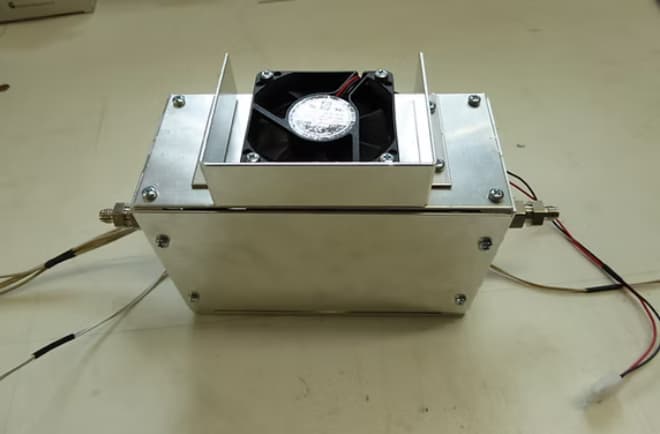
The column is then heated which releases the siloxanes from the media and they are carried by a N2 carrier gas into the measurement cell. The cell comprises a Infrared source, filters and an pyroelectric detector mounted behind specialised windows. As the carrier gas passes through the cell the siloxanes cause absorbance of the IR signal so the received signal by the detector falls and produces and equivalent voltage drop. This is recorded and processed to produce a mass of material which when calculated with the sample volume produces a reading in mg/m3.

The monitor produces a total siloxane reading which is the sum of the various species from L3 through to D6. The unit is usually calibrated using either D4 or D5 dependent on the site as these tend to form 80%+ of the siloxanes seen and are also the most damaging being the larger molecules.
 

Reading Output

Reading Output

The monitor produces a total siloxane reading which is the sum of the various species from L3 through to D6. The unit is usually calibrated using either D4 or D5 dependent on the site as these tend to form 80%+ of the siloxanes seen and are also the most damaging being the larger molecules.


CONTROL CARBON FILTER
COSTS
ONLINE & ONSITE DATA
ACCESS
LOW MAINTENANCE
DESIGN
PRE-PACKAGED READY
FOR INSTALL
24/7 - 365
OPERATION

Already trusted by…

WHAT OUR CLIENTS SAY

RESULTS THAT SPEAK FOR THEMSELVES

Customers like the concept of both the contamination simulators as well as the dose rate simulators.

Eugene | STRATEC SERVICES

We have been working with STS for a number of years and we value our relationship with them. They continue to be an important supplier in the provision of services and solutions, to support our work in radiation monitoring in a secure and safe environment.

Trevor | AWE

A lecturer in applied physics and in radiation protection at Aix Marseille University in France. I have been using STS products for 6 years, and I highly recommend them. Easy to use and very realistic…

Frank | AIX MAIRSEILLE UNI

The equipment we purchased has been brilliant and has made a real difference to some of the training we are doing here at Dungeness B Power Station. Further to this, you managed to meet our tight time frames, and get this equipment to us in such a short space of time which was exceptional service and is truly appreciated, thank you!
Darren | EDF NUCLEAR OPERATIONS
Get A Quote

REQUEST A QUOTE

Sign up to Mailing List