Discover more about how our simulators work and how the technology is used to replicate ionising radiation fields and surface contamination.







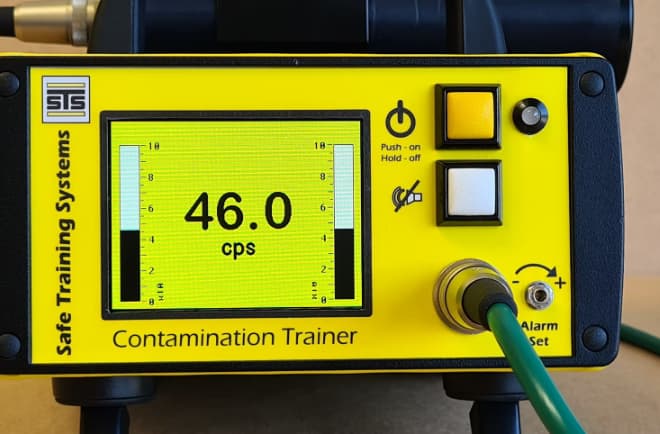
Specialising in the conversion of standard instruments for training purposes.
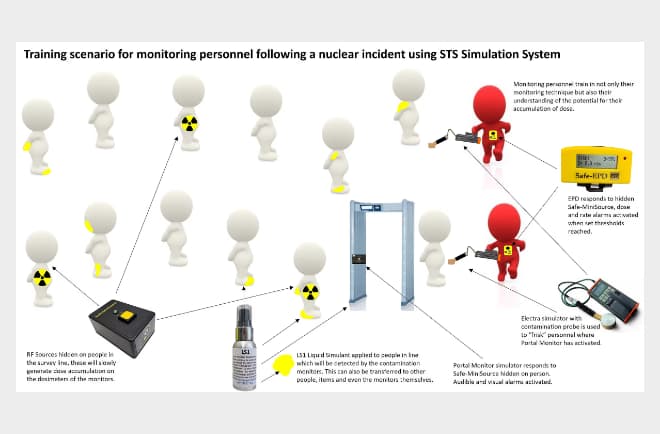
A range of instruments from the Thermo RadEye & Rotem Ram Gene to the Thermo Electra and Mini 900 are available all designed to replicate the response and characteristics of the real instruments. STS Simulators are able to replicate the characteristics of contamination from radioactive sources including cross contamination where clothing, skin or environmental contamination may occur; this is not possible to achieve with a real source scenario without undue exposure to the trainee.
If real sources are used, every training session poses an additional cumulative dose to the trainer, while the trainee receives only the dose resulting from the session attended. Training with real radiation sources requires a considerable amount of paperwork to move sources, even very small ones, from secure areas, to “open field” exercise areas, using time which could be more productively used. STS simulators solve these problem– the trainer has no cumulative exposure from each training session and the trainee can make serious mistakes without any hazard to anyone.
STS simulators allow training to progress from “no knowledge” to a full understanding of instrument controls, the relationship of source position, instrument position and meter reading. Ultimately, as simulators cannot recreate the 1:1 million dynamic range of modern survey instruments, trainees will need to make measurements with real instruments and sources under supervision. However, their performance will be much more self-assured and confident if they have progressed to that point via good simulation training.
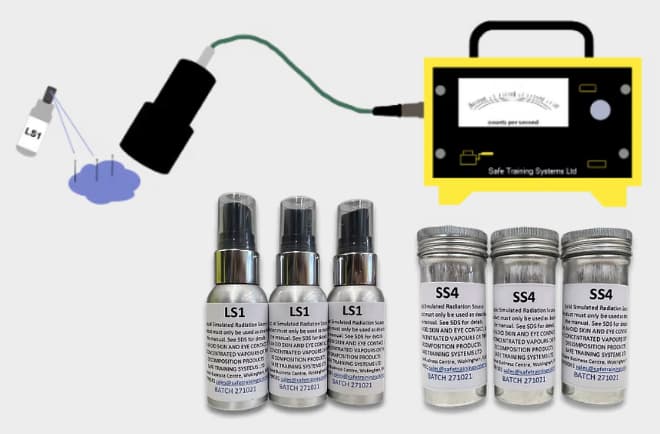
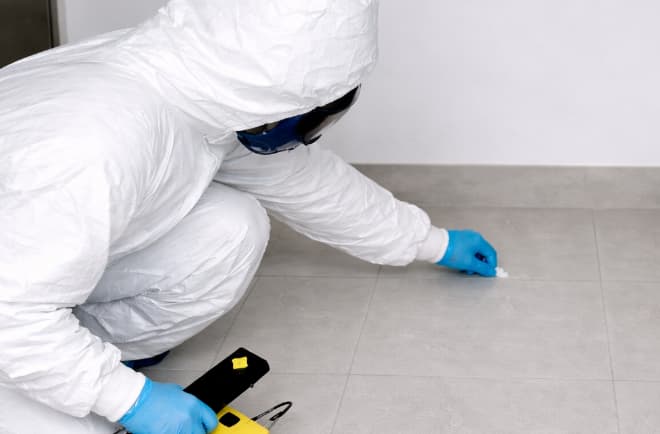
The STS Mini 900 employs unique gas sensing technology for contamination training, using a safe liquid simulant, STS LS1, or SS4 powder. When applied to surfaces, LS1 creates a dense gas cloud that remains within 2 cm, allowing a modified meter or smart probe to detect signals ranging from 2000cps at close contact to background at 2 cm. This system encourages proper monitoring technique, as rapid or distant probe movement yields little gas capture.
The simulant’s effectiveness varies with surface type, temperature, and time, typically lasting up to two hours and fully evaporating within 24 hours to prevent residual interference. Its sticky nature facilitates realistic demonstrations of contamination transfer and decontamination procedures through wiping or washing. Both LS1 liquid and SS4 powder simulants are available in boxes of 10.
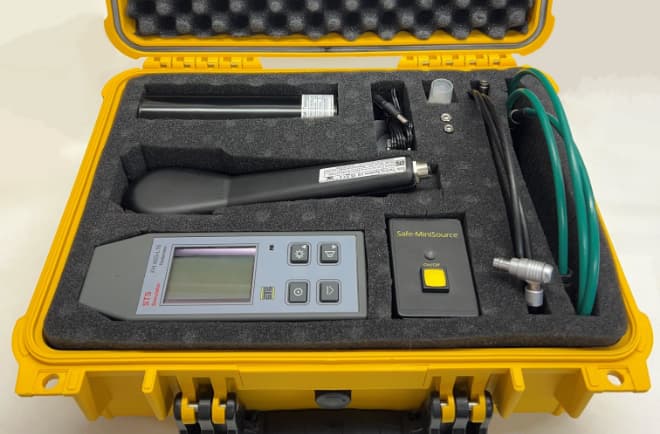
Handheld Radiation Instrument Simulation
The New STS Safe-Series is the latest development in hand held radiation instrument simulation providing the most realistic experience yet for trainees in the Nuclear Industry, Homeland Security and Emergency Services.
This new system has been developed to as closely as possible mimic a real ionising radiation field and the detection instruments have been designed to replicate the real response an instrument would give.
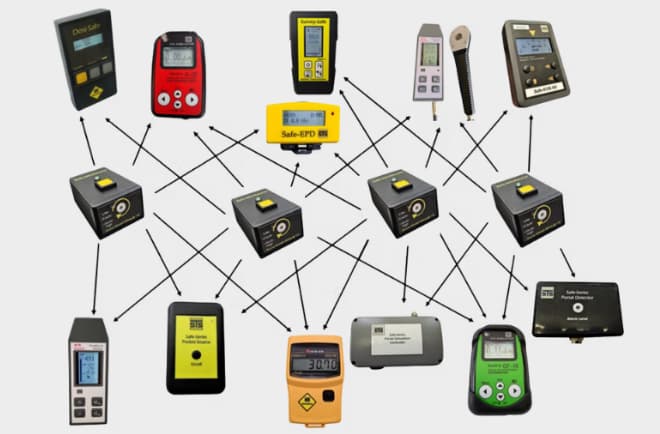
The simulated field is generated with a Radio Frequency source which utilises a unique antennae design producing a near isotropic field of simulated radioactivity. The field is emitted in all directions out to a distance of approximately 15M depending on the activity level set on the source. The Safe Series Mini-Sources are extremely compact measuring just 80x60x40mm, and therefore ideal for covert training for either emergency planning, source retrieval or CBRN exercises. The sources are available in either a fixed activity level, which may be selected individually on ordering, or a variable activity with a choice of 10 settings. The flexible software allows for simulated radiation fields up to 10Sv/hr to be generated and down to 0.5uSV/hr for subtle applications. STS Safe-Survey Meters and Dosimeters’ detector alarm and background levels can be pre-set such that they are in line with real instruments used by trainees. The real benefit of the STS Safe-Series instruments comes when group training is required. Up to 16 units can be fielded at any one time and in any combination.
So 6 participants can all have a survey meter operating, whilst wearing a Safe-EPD or Dosi-Safe dosimeter and 4 sources of different field strengths can also be fielded- as on the right. All of the units talk to each other and the effect of having multiple sources means an accumulated field strength is registered on the instrument. Exercises may therefore be conducted to demonstrate the hazards involved where multiple sources are located and a large source may be masking the activity of other weaker sources. The Safe-Series system requires no trainer input, except to set up the background and alarm levels required before commencing a training session. Levels once set are remembered by the system so that next time the units are ready to go without adjustment. On delivery, the instruments are set to the customers requested setting before being dispatched.
Both Dosimeters and Survey meters have LED alarm lights; activated once the alarm threshold is breached, and audible buzzers (approx 80DB) which sound on the thresholds of either rate or dose alarms. On the dosimeters, the alarm has to be acknowledged in order to stop the unit from sounding, each alarm has a different tone with the final dose alarm being an uninterrupted tone. The radio frequency system allows the signal to be read though materials such as wood, brick, glass and plasterboard – and the signal received by the instrument is attenuated differently for each material.
The system is therefore particularly suited to demonstrating the effects of distance (inverse square law), shielding and time on the trainees received dose. As new instruments are developed by STS, they are manufactured so they will all continue to work with the existing system. So new instruments can be incorporated into existing Safe Series framework without needing to replace existing equipment.






Customers like the concept of both the contamination simulators as well as the dose rate simulators.

We have been working with STS for a number of years and we value our relationship with them. They continue to be an important supplier in the provision of services and solutions, to support our work in radiation monitoring in a secure and safe environment.

A lecturer in applied physics and in radiation protection at Aix Marseille University in France. I have been using STS products for 6 years, and I highly recommend them. Easy to use and very realistic…

The equipment we purchased has been brilliant and has made a real difference to some of the training we are doing here at Dungeness B Power Station. Further to this, you managed to meet our tight time frames, and get this equipment to us in such a short space of time which was exceptional service and is truly appreciated, thank you!