How It Works

Discover more about how our simulators work and how the technology is used to replicate ionising radiation fields and surface contamination.
What Simulation would you like to achieve?

Surface Contamination
Technology (Gas Ionisation)
Instrument Formats
Instrument Formats
Application
Application
  • Simulation of moveable ionising activity on surfaces
  • Alpha & soft beta simulation
  • Transferable cross contamination
  • Simulant may be removed with standard decontamination products
  • Zero dose – harmless clear non-toxic simulant
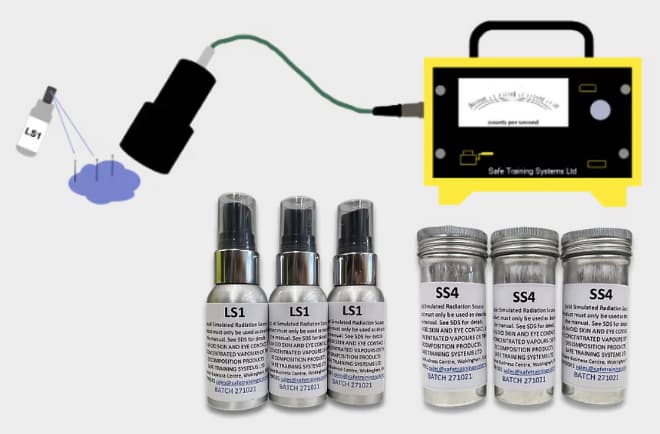
  • The Contamination system utilises an ionising corona discharge system- the simulant applied to the surface releases a small gas cloud as it evaporates – this is pulled into the detector by a small fan and the resultant drop in voltage when the gas is ionised is output as counts on the meter
  • The range of detection is designed to replicate alpha and soft beta radiation, so the signal is detectable at up to ~4cm from the surface.
  • Simulants are available as liquids in a spray pump or a granular solid (silica based)
  • Smart Probes – these probes connect directly to a real unmodified rate meter and contain all the simulation electronics and detection circuits and also power supply- for example Smart DP6 probe used with a Real RadEye SX meter
  • Standard Probes – these probes contain only the detection circuit – they require power and signal from the host meter- this does mean they can be smaller in form such as a HP260 style frisker probe
  • Converted Meters – STS can take existing Contamination meters and convert them into simulated instruments this involves adding additional circuitry and sometimes power supply into the meter and interfacing with the meters electronics to feed the simulation signal in to the host device – for example the RamGene 1 MK11 or the Ludlum Model 3
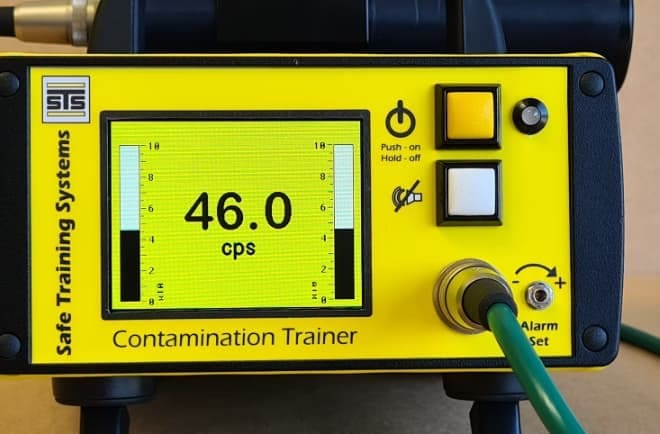
  • Generic Meters – These meters are built entirely by STS from the ground up, they are designed to replicate the look and feel of real meters but with an up to date interface and display – they can be used with any of the STS standard probe range ie 44A, Dp6, Hp260 etc – an example of this is the Contamination Trainer or Contamination monitor Simulator
  • All in One/Dual instruments – These instruments provide a cross over by offering both a contamination and a radiation simulation- utilising 2 different technologies – The Dual FH40 can have either a contamination probe or a gamma probe connected
  • Contamination – Applying the LS1 simulant to a surface will “contaminate” the surface and remain in place for up to 2hrs.
  • Cross Contamination – the applied simulant can be moved to different locations- either purposefully or by accident! The trail of contamination can then be followed to establish the spread and to determine next actions required.
  • Decontamination – having identified and demarked the contaminated area decon can be applied to remove the simulant – the area, the cleaning materials, and the person doing the work can then be re monitored to ensure compliance.
  • Barrier Control- The simulation system may be used to impose a barrier control to a training area where trainees are monitored on exit to demonstrate the importance of controlling the spread of contamination
  • Training Scenarios – lots of scenarios can be set up using this kit – you can see some examples here
Radiation Field Simulation
Technology (Radio Frequency)
Instruments Formats
Instruments Formats
Application
Application
  • Simulation of Ionising Radiation Fields
  • Demonstration of Inverse Square Law through decreasing signal over distance
  • Demonstration of Shielding and Attenuation of different materials
  • Demonstration of time in field vs received dose
  • Zero real dose received to trainer or trainee, no paperwork required, repeat training exercises to refine practical processes
  • The Radiation simulation system the “Safe series” operates in the IEEE 802.15.4 (2405-2480MHz) unlicensed band as a Proprietary 802.15.4 RF device.
  • These instruments operate at 2440MHz, with Direct spread spectrum. The unit transmits at a measured ~0dBm with an antenna gain of 1. The data packets contain addressing and command information, following the IEEE 802.15.4 standard.
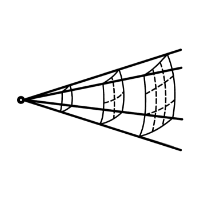
  • The system comprises a “Source” which generates a near omnidirectional RF field and a detector which locates the source and measures the strength of the radiated signal – this is then processed and displayed in Sv/hr or Mrem/hr
  • The range of the system is up to 15 metres – this will depend on the environment and objects between the source and detector which may attenuate the signal.
  • A network of up to 16 units can be fielded to produce complex training scenarios
  • Being a radio-based system metal enclosures will completely attenuate the field but other materials will attenuate it according to their density and thickness.
  • Converted Meters – STS can take existing Survey meters and convert them into simulated instruments this involves adding additional circuitry and sometimes power supply into the meter and interfacing with the meters electronics to feed the simulation signal in to the host device – for example the RDS30 or the RadEye G10
  • Generic Meters – These meters are built entirely by STS from the ground up, they are designed to replicate the look and feel of real survey meters and offer a more cost effective solution– an example of this is the Survey Safe.
  • FH40 Gamma Probes – these probes contain only the detection circuit – they require power and signal from the host meter but can be used on a cable or mounted on a telepole.
  • Dosimeters – the “Safe EPD” is a dosimeter based on the Thermo EPD – it offers the same functionality in rate and dose alarms with user selectable alarm levels, the screen outputs both the rate and accumulated dose and a chirp may be set if required.
  • Sources- STS offers 3 different mini-sources , manually operated variable strength source , a remote control variable strength source and a slimmer “pocket” source. These have between 8 and 10 different output levels with a standard range of 2.5µSv through to 5mSv
  • All in One/Dual instruments – These instruments provide a cross over by offering both a contamination and a radiation simulation- utilising 2 different technologies – The Dual FH40 can have either a contamination probe or a gamma probe connected.
  • Field Survey training – identification of quantification of a source
  • Barrier Control – setting up a barrier to control access given the result of a survey
  • Lost source recovery – sources may be hidden in non-metallic containers such that trainees must search for the source, and act accordingly
  • Basic teaching of time, distance and shielding
  • Multi instrument scenarios involving meters, sources and dosimeters to establish emergency procedures or to test maintenance regimes and protocols.
  • Training Scenarios – lots of scenarios can be set up using this kit – you can see some examples here

Surface Contamination

STS Contamination Simulation System

STS Contamination Simulation System

Specialising in the conversion of standard instruments for training purposes.

A range of instruments from the Thermo RadEye & Rotem Ram Gene to the Thermo Electra and Mini 900 are available all designed to replicate the response and characteristics of the real instruments. STS Simulators are able to replicate the characteristics of contamination from radioactive sources including cross contamination where clothing, skin or environmental contamination may occur; this is not possible to achieve with a real source scenario without undue exposure to the trainee.

Limiting the exposure of the trainer

Limiting the exposure of the trainer

If real sources are used, every training session poses an additional cumulative dose to the trainer, while the trainee receives only the dose resulting from the session attended. Training with real radiation sources requires a considerable amount of paperwork to move sources, even very small ones, from secure areas, to “open field” exercise areas, using time which could be more productively used. STS simulators solve these problem– the trainer has no cumulative exposure from each training session and the trainee can make serious mistakes without any hazard to anyone.​

STS simulators allow training to progress from “no knowledge” to a full understanding of instrument controls, the relationship of source position, instrument position and meter reading. Ultimately, as simulators cannot recreate the 1:1 million dynamic range of modern survey instruments, trainees will need to make measurements with real instruments and sources under supervision. However, their performance will be much more self-assured and confident if they have progressed to that point via good simulation training.
Technology

Technology

The STS Mini 900 employs unique gas sensing technology for contamination training, using a safe liquid simulant, STS LS1, or SS4 powder. When applied to surfaces, LS1 creates a dense gas cloud that remains within 2 cm, allowing a modified meter or smart probe to detect signals ranging from 2000cps at close contact to background at 2 cm. This system encourages proper monitoring technique, as rapid or distant probe movement yields little gas capture.

The simulant’s effectiveness varies with surface type, temperature, and time, typically lasting up to two hours and fully evaporating within 24 hours to prevent residual interference. Its sticky nature facilitates realistic demonstrations of contamination transfer and decontamination procedures through wiping or washing. Both LS1 liquid and SS4 powder simulants are available in boxes of 10.
Radiation Field

Handheld Radiation Instrument Simulation

STS Radiation Field Simulation System

Handheld Radiation Instrument Simulation

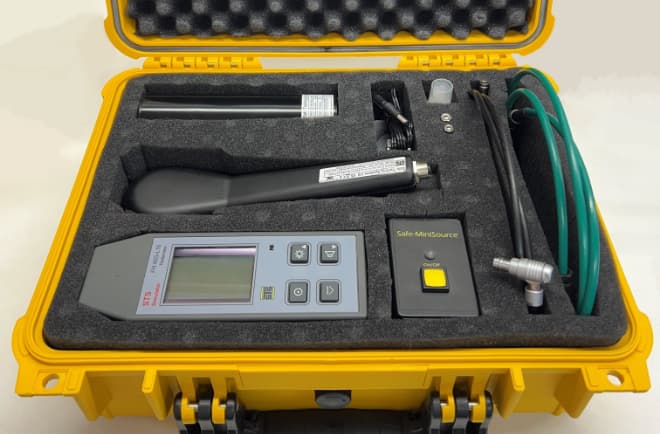
The New STS Safe-Series is the latest development in hand held radiation instrument simulation providing the most realistic experience yet for trainees in the Nuclear Industry, Homeland Security and Emergency Services.

This new system has been developed to as closely as possible mimic a real ionising radiation field and the detection instruments have been designed to replicate the real response an instrument would give.

STS Safe-Survey Meters and Dosimeters

STS Safe-Survey Meters and Dosimeters

The simulated field is generated with a Radio Frequency source which utilises a unique antennae design producing a near isotropic field of simulated radioactivity. The field is emitted in all directions out to a distance of approximately 15M depending on the activity level set on the source. The Safe Series Mini-Sources are extremely compact measuring just 80x60x40mm, and therefore ideal for covert training for either emergency planning, source retrieval or CBRN exercises. The sources are available in either a fixed activity level, which may be selected individually on ordering, or a variable activity with a choice of 10 settings. The flexible software allows for simulated radiation fields up to 10Sv/hr to be generated and down to 0.5uSV/hr for subtle applications. ​STS Safe-Survey Meters and Dosimeters’ detector alarm and background levels can be pre-set such that they are in line with real instruments used by trainees. The real benefit of the STS Safe-Series instruments comes when group training is required. Up to 16 units can be fielded at any one time and in any combination.
Radiation Field Simulation System

Radiation Field Simulation System

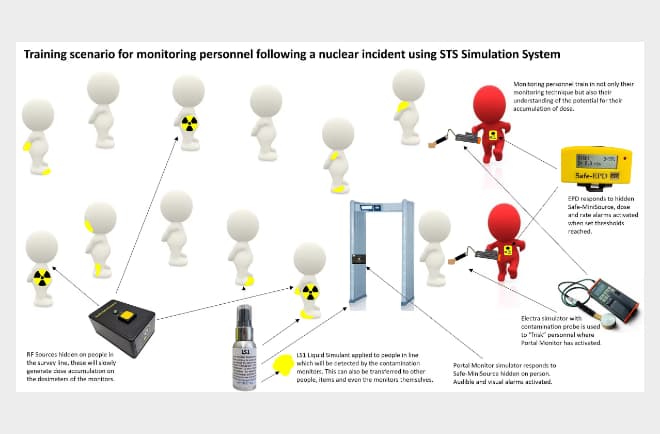
So 6 participants can all have a survey meter operating, whilst wearing a Safe-EPD or Dosi-Safe dosimeter and 4 sources of different field strengths can also be fielded- as on the right. All of the units talk to each other and the effect of having multiple sources means an accumulated field strength is registered on the instrument. Exercises may therefore be conducted to demonstrate the hazards involved where multiple sources are located and a large source may be masking the activity of other weaker sources. The Safe-Series system requires no trainer input, except to set up the background and alarm levels required before commencing a training session. Levels once set are remembered by the system so that next time the units are ready to go without adjustment. On delivery, the instruments are set to the customers requested setting before being dispatched.

Both Dosimeters and Survey meters have LED alarm lights; activated once the alarm threshold is breached, and audible buzzers (approx 80DB) which sound on the thresholds of either rate or dose alarms. On the dosimeters, the alarm has to be acknowledged in order to stop the unit from sounding, each alarm has a different tone with the final dose alarm being an uninterrupted tone. The radio frequency system allows the signal to be read though materials such as wood, brick, glass and plasterboard – and the signal received by the instrument is attenuated differently for each material.

The system is therefore particularly suited to demonstrating the effects of distance (inverse square law), shielding and time on the trainees received dose. As new instruments are developed by STS, they are manufactured so they will all continue to work with the existing system. So new instruments can be incorporated into existing Safe Series framework without needing to replace existing equipment.


Already trusted by…

WHAT OUR CLIENTS SAY

RESULTS THAT SPEAK FOR THEMSELVES

Customers like the concept of both the contamination simulators as well as the dose rate simulators.

Eugene | STRATEC SERVICES

We have been working with STS for a number of years and we value our relationship with them. They continue to be an important supplier in the provision of services and solutions, to support our work in radiation monitoring in a secure and safe environment.

Trevor | AWE

A lecturer in applied physics and in radiation protection at Aix Marseille University in France. I have been using STS products for 6 years, and I highly recommend them. Easy to use and very realistic…

Frank | AIX MAIRSEILLE UNI

The equipment we purchased has been brilliant and has made a real difference to some of the training we are doing here at Dungeness B Power Station. Further to this, you managed to meet our tight time frames, and get this equipment to us in such a short space of time which was exceptional service and is truly appreciated, thank you!

Darren | EDF NUCLEAR OPERATIONS
Get A Quote

REQUEST A QUOTE

Sign up to Mailing List